Tuesday, 29 September 2015

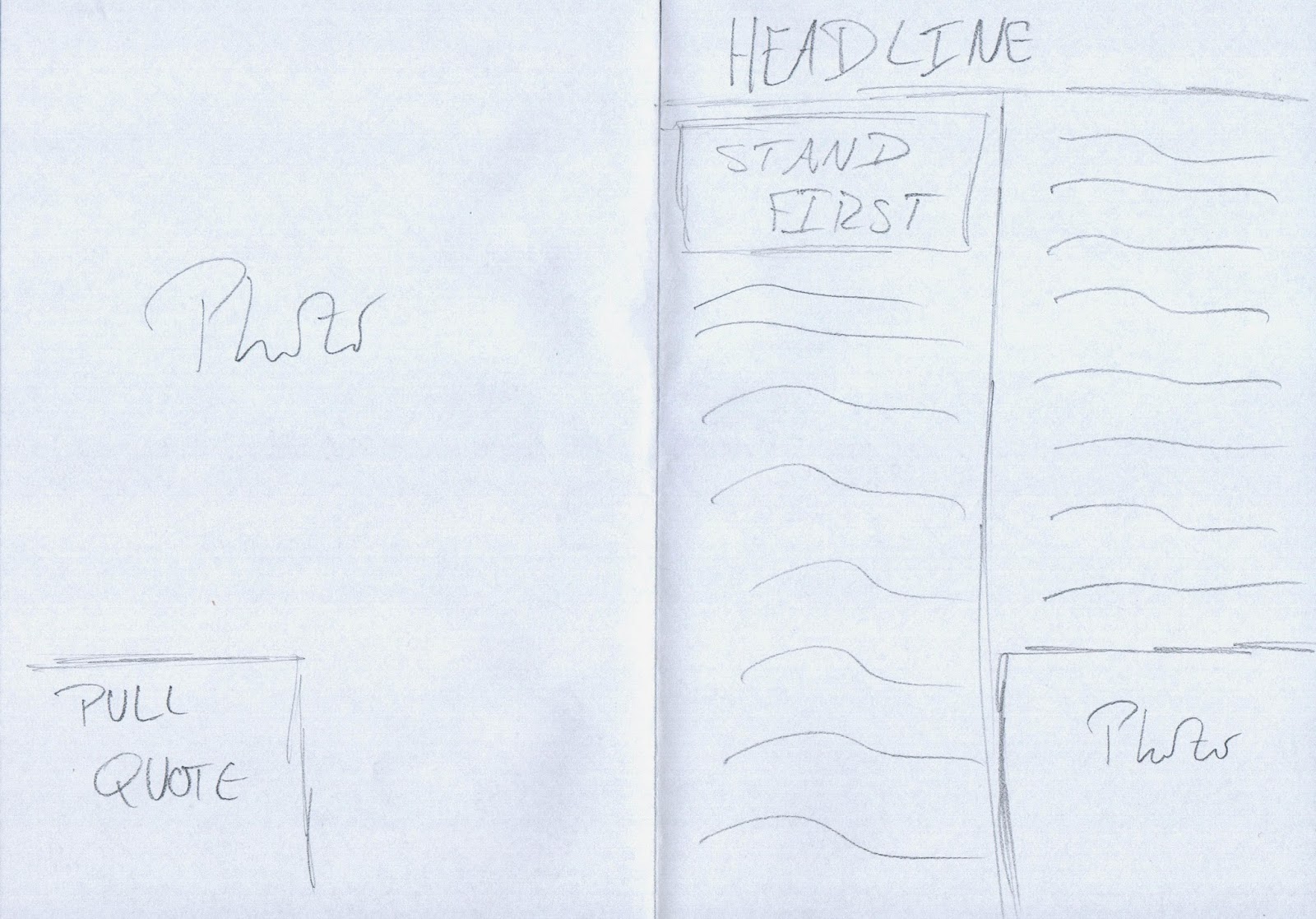
3 Double Page Spread Drafts

1


2

3


Many film magazines follow the same format as any other type of magazine with tendencies like Headlines, stand firsts and drop caps. Therefore, I decided to use the knowledge I developed last year when making a music magazine to inform my drafting process.

Option 1 is possibly my favourite as it involves having the whole background as an image which is a very immersive way to present a review. It is also fitting with my genre which is occasionally decadent whilst being immersive and beautiful. Therefore, if when shooting on location I take a strong image of my cast this kind of layout lends itself to such imagery.

Option 2 is perhaps more conventional for a film review because of the layout and the spacing. It also has two images from the film instead of one which means a potential audience member can see more of the work and thus is more likely to be attracted to seeing it. There is also more room for text within this layout which means more content can be placed on the page and, usually, the more information about a film the better. The room for pull quotes and larger sections of texts are also a good way to grab a glancing reader’s attention if an interesting statement is placed.

Option 3 feels more basic than the other layouts but this is not necessarily a bad thing. This is a good possible layout as it is clear and to the point. It equally allows the reader to be attracted by an image as it does to be attracted by a pull quote or interesting headline. 

3 Film Poster Drafts


1


2


3


After studying other film posters of my genre, I was inspired that my poster should be in a rural setting as my entire short film is set outside. I will also have my actors in the clothes used in filming due to continuity reasons. It is most likely that I will shoot the image used on my poster on location alongside my film to make sure they look the same but also to ensure the backgrounds are the same.

All drafts, in my opinion, will be equally as fitting for my genre and short film as the other. However, I particularly like the layout of Option 1 as I feel it conveys the dynamics of my characters relations very well and would entice a possible audience member to find out more. I also like Option 1 because, if well edited, it will be aesthetically pleasing with bright dark browns and greens to contrast my actors clothing

Option 2 would be equally as aesthetically pleasing due to the use of dramatic silhouettes and nature surrounding them. Also, as they are all walking in the same direction, there is a sense of mystery and wonder as to where they are going. If I do go with this layout, I will ensure that my female protagonist is leading the men to show that she is the leader and cause of the drama within the piece.


Option 3 is possibly my least favourite as it seems, to me, as if the characters are too static and separate. Bearing in mind that the period drama is about deep character relations, this kind of poster feels false and too far away from my genre’s tendencies. 

Monday, 28 September 2015

Costume Development


In theory

Whilst I was writing my script, I found myself thinking about how my characters would look. I imagined:

- Charlotte in a larger dress, with bright colours such as red or blue, to show that she is a wealthy woman and wears what many woman of her status (upper class) would have worn within the period. I did consider her to have worn veils and gloves but I think she is too honest for such add-ons. I also think she would have a favourite dress and tries to remain simple.

- Tess in a muted coloured dress (beiges and creams) as she is not the main character and is slightly below Charlotte in terms of wealth. I also imagine her dress to be more slim and less large or full as Charlottes.

- Johnson in formal wear yet, seemingly, casual. This means no tailcoat or jacket – just a waistcoat and shirt to show that he is slightly unhinged (especially in the final scene). To be contextually relevant, though, I will have him wearing a cravat instead of a tie.

- James should have two different outfits. For Butler, he should be in a white shirt and black bow tie as this is the wear of an archetypal butler and the audience will get it immediately. For James, I would like him in a beige top and trousers to imply a sense of simplicity and austerity.


In practice:

In terms of my male characters, I had no problem sourcing their costumes as I simply found items of mine or friends clothing that fit the specification (such as 100% cotton shirts), so my male characters ending up looking how I described above (or close enough to).

As I do not have a costume budget, I went into my schools Drama departments stock to see what type of dresses I had to work with for the girl characters. These were my top selections:


It seemed instantly obvious to me that this dress (on the right - red and green) was the perfect dress for Charlotte to wear as it felt opulent yet humble enough for her to wear. I also felt that the dress was innocent, due to the floral pattern, yet strong due to the green paneling over the top. 


For Tess, though, I had more options: 


1234


As I wanted Tess to less opulent than Charlotte, and more hard working, I found that all of these options would be wearable. However, I very quickly discarded 1 and 2 as they were not complete dresses and were either broken or too short for the era. I also discarded 3 quickly as I felt it was rather peasant girl, and the early 18th Century didn't have many peasants and even the servants wore cleaner outfits with more detail. Eventually, I chose the beige patterned one (the one on the left) as I felt it was the most in keeping with my eras and characters modest tendencies. It was also not as colourful as 4, which means the dress isn't going to distract the viewer from the more important dress - Charlottes. 

I also found these two  black capes and covers: 


As I will be shooting outside, these capes will add to the effect of my characters being cared for and rural. The longer black cape would also be effective for Charlotte to wear when adventuring into the woods as it implies a sense of secrecy and mystery. She is, after all, committing a very serious crime within the period. 

Contextual Thoughts


Recently I have become increasingly aware that to create a successful period drama, you must be aware of the time-frame of which you are telling your story in. Of course, to carry out a comprehensive study of the period would be impossible due to time constraints. Therefore, I shall use the knowledge I already have alongside some base research in order to make a product that is professional and in-keeping with professional competitors and conventions.

I have chosen the late 18th and early 19th Century as a setting. This will influence my piece in these main ways:

- Most glaringly obvious are the choices surrounding costume. Of course, I do not have the budget to go extravagant with my costumes. I just need to make sure that the choices I do make are coherent. There will be a separate post about costume as I feel it is quite an extensive discussion and will overflow this post.

- In this time period, there was a growing number of Romantic writers, like Blake, and realist writers, like Austin. This means that language was savoured and was delicately chosen by the educated. This is why the gaps between the classes was so evident – because of the gaps in education. For example, Bronte in 'Wuthering Heights' purposely writes the servants dialogue, Joseph, in a riddling unreadable way to exaggerate the effects of the class system. In short – how one character speaks should imply their status and their education. This means that much care should be taken during the script writing process but also during the rehearsal with actors to make sure that the viewer can understand the characters as quickly as possible.

- As I, sadly, do not have the facilities or the budget to film at an old manor house or a stately home – I have decided to film in natural settings as many of the period dramas I have analysed are inspired by the pastoral and the rural. Bearing in mind that many people spent time outside within this era in order to play and to entertain themselves.This does arise problems, though, as I will be filming in changing seasons therefore my script and planning must compensate for this, to ensure that there are no continuity problems. The locations must also feel authentic (with no signs of the modern world) and isolated – so I am currently thinking that a woodlands or forest would be best for the bulk of filming.  

Script - In the Woods


Tuesday, 22 September 2015

Spider Diagram of Plot Ideas

In order to be ensure clarity within my work and process, I first made a list of my top 5 plot ideas; 


After considering all these 5, I then decided to develop and draw out the top 3 ideas that I preferred; 


1

24


I then began to talk some of my peers and teachers through the 3 ideas to see what would work best within the short film period drama genre. I decided that Plot Idea 1 (A Woman has 2 lovers) worked the best in terms of levels of drama and narrative within 5 minutes. It also brought up themes of Class Division and Romance (which were preferred in my survey) as well as having pastoral elements and a definite ending

I then began to develop my script and advance towards production. 

Sunday, 20 September 2015

Camera Workshop

As part of my process, I partook in a camera workshop to ensure I was cinematically ready for filming and to ensure I was prepared for the problems that may arise when filming. The things I learnt were:

● Be aware of principle shots and have a detailed shot list. Improvisation on a set isn’t always productive.

● Try to avoid taking shots without a tripod unless I want a handheld or POV feel (which I most likely will not as this is not conventional for my genre).

● Leave around 3 seconds before and after a take in order to allow myself editing time.

● When composing / placing a shot make sure that I keep to the rule of thirds in order to make an aesthetically pleasing shot. Also, make sure that there is headroom within a shot as cutting off the top of an actors head looks unprofessional.

● When filming a tracking shot use a dolly cam (if the terrain allows it) and make sure you leave walking room within a shot in the direction the actor is walking.

● There is a big difference between zooming and progressively moving with the camera. To dolly the shot looks more professional as it gives the shot more depth of field as more is changing in the visions of the viewer.

● When getting into a performance space, spend the time to do detailed blocking and rehearsal with your actors to ensure the shots you create are professional and usable.

● Film a conversation / scene at least 3 times from different angles. As my films is dialogue based and is a period drama, I will need to film many different angles (especially since each scene has a minimal of 3 people).

● Never cross a line of actions. Meaning that all drama should be shot from the same side as it means it will always have the same background.

● Be aware of the importance of continuity. Take pictures of the set and actors in detail in case re-shoots have to take place and the shots used in the final take feel natural and in the same time frame.

● When framing, ensure that the light does not limit the depth of field (unless this is what is desired). Light is important as it, essentially, effect mise-en-scene but also the aesthetic of your shots.


● In terms of camera positioning and movement there is a lot to consider. The main points being that all shots shot be considered, from low angle to high angle, from static to shaky. They all convey something and it is my job as director to ensure these shots are thought out deeply and properly.